
Global vintages back to average, according to Wine Australia
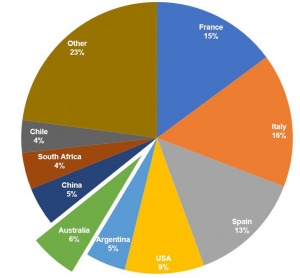
With Southern hemisphere harvests nearing completion and winter over in the North, the early indications are for a return to a more average global harvest in 2018, according to Wine Australia.
Argentina for one is expecting a grape harvest in the region of at least 2.2 million tonnes, a return to a more average size, which should propel the country to push ahead of Australia again to become the world’s fifth largest wine producer. It is also forecast that Chile willhave a larger crop after two years of low production. New Zealand, meanwhile, will see a lower than initially forecast crop due to ongoing wet weather and the resultant disease pressure.
In the Northern hemisphere meanwhile, Europe has made up for a dry start to winter with good rainfall in March and April in Spain, France and Italy, meaning that harvests are not likely to be hampered by a dry winter, although it is still too soon to predict the likely size of the crops in these countries so early in the season.
California has also received good autumn rain and is “well positioned” at this stage for a normal harvest. Only South Africa looks like it will have a significantly below-average crop as a result of the prolonged drought gripping the Western Cape.
However, as Wine Australia points out, even a 50% reduction in South African volumes ( as some producers are predicting), would result in only around 0.5 billion litres less in a world market that of between 25 – 30 billion litres.
France, Italy, Spain and the US together account for more than half the global crush, while Australia increased its share from 5% to 6% in 2017, after a relatively large harvest.
With a history of fairly consistent production, Australia sees less variation in the size of its crop than most other major wine producing countries. Early signs are that the 2018 Australian crush will be down on the record 2017 volumes, while grape prices are expected to increase in line with increasing average export prices.
There has historically been a strong correlation between export demand and grape pricing, and the latest export figures show an increase in the average value of 5% to $3.14 per litre, while bottled export value hit a record of $5.74 per litres FOB.