
First vineyards planted in Bhutan with more to follow
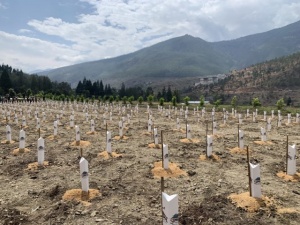
Two small vineyards have been planted in the Himalayan kingdom of Bhutan, the first of five planned for the mountainous region.
Although the vineyards only cover just over six acres, the long term plan is for them to gradually expand as the best sites and varieties are discovered.
American MW student Mike Juergens first noticed the wine growing potential of Bhutan when he ran a marathon there and thought that the conditions could be “id eal for wine” with lots of iron rich soils and south facing slopes. On his return to the US, he wrote a white paper for the government outlining the possibility of introducing viticulture into the country.
Juergens, who lives in California, thought that this represented a “glorious opportunity” to introduce winemaking in a country entirely devoid of viticultural heritage – or baggage, and starting an industry entirely from scratch. "To be able to build not just a vineyard but a whole region,” he said. “It was way too good an adventure [to pass up],” he told Drinks Business.
After several years, Juergens found a partner to help him with the project, and nine varieties were chosen for an initial trial planting, with the varietals including Merlot, Cabernet Sauvignon, Cabernet Franc, Syrah, Pinot Noir, Malbec, Sauvignon Blanc, Chardonnay and Petit Manseng.
Situated at various places around the country to exploit the various different climates of the country, Juergens said they were “trying vineyard styles from terraces to flat and with all these different things in play we hope we’ll dial in quickly on what is working and then change accordingly.”
The highest vineyard that will be planted is at 2,700 metres above sea level, not quite as high as the highest in the world, which are situated in Argentina. As well as his faith in the climate, another attribute is the Bhutanese themselves.
“If there’s one thing the Bhutanese are good at it’s agriculture,” said Juergens. “Their site prep was as good as I’ve ever seen in the world.” Another advantage is the relatively pristine nature of the land, in a carbon neutral country where sustainable practices are well established and nearly 100% of agriculture is organic.
“It’s completely untapped,” said Juergens “and it’s protected on all sides by mountains. If you’re a phylloxera louse it’s pretty hard to sneak over K2 to snack on a vine.”
The only forseeable problems Juergens predicts will be birds and frost. All that considered, the vines will therefore be worked organically. But gorwing the grapes is only half the battle as there are – as yet – no wineries. However, Juergen has said he is going to build a winery in Bhutan, though he hasn’t established the exact location. Anotehr problem is the lack of winemaking ability in the country, though Juergens said he will be looking to bring in a team of experts to help .
Ultimately he said he hopes to introduce wine grape growing to smallholders, and thereby create a small co-operative system. However, he says the main focus is going to be on terroir focused wines. “Ther are a range of microclimates and the idea is to produce terroir wines not bulk. I’m not interested in $5 bottles of plonk. We really want to dial in on terroirs and levareage those. This is along tern project and we’re picking top quality sites.”